
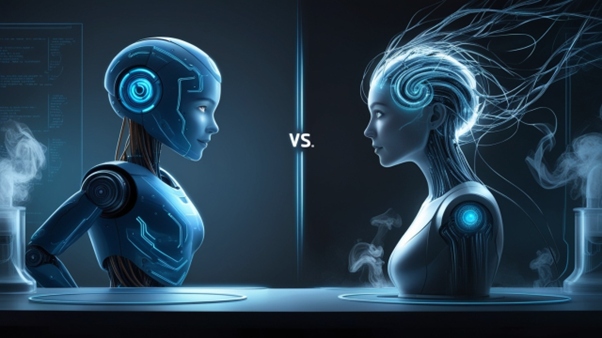
Once a fantasy confined to the pages of science fiction, Artificial Intelligence (AI) has now become one of the most transformative forces of our time. It powers search engines, runs smart homes, drives cars, assists doctors, and even predicts what you’ll want to watch next. But beneath this widespread adoption lies a deeper battle—between two distinct paradigms of intelligent systems.
In today’s AI landscape, two models stand out: Agent AI and the emerging concept of Agnetic AI. Both stem from the intelligent agent framework—machines that perceive, decide, and act—but they diverge dramatically in architecture, adaptability, and ambition.
This article will guide you through the strengths, weaknesses, and use cases of both paradigms. By the end, you’ll not only understand their mechanics but also gain insight into which is better suited to lead the next frontier of human–machine collaboration.
Agent AI refers to systems designed to operate autonomously within an environment to achieve predefined goals. Think of them as digital “specialists”—task-focused, efficient, and reliable.
Core Characteristics:
Types of Agent AI:
Applications:
While Agent AI is robust and reliable, its strength is also its limitation: it struggles in unpredictable, dynamic environments where adaptability is essential.
Agnetic AI represents the next evolutionary leap in intelligent systems. The term “Agnetic”—inspired by “magnetic”—highlights its dynamic, adaptive, and interconnected nature. Unlike Agent AI, which is rigidly goal-bound, Agnetic AI evolves, collaborates, and responds to human and environmental context in real time.
Key Features of Agnetic AI:
Applications:
In short, Agnetic AI shifts AI’s role from fixed-task executor to context-aware collaborator, opening doors to more intuitive and human-like interaction.
Agent AI and Agnetic AI are built on very different foundations.
In short: Agent AI is reliable in predictable, rule-based situations, while Agnetic AI is built to evolve, collaborate, and thrive in real-life complexity.
The future of AI may not be a rivalry but a synergy. Agent AI’s consistency and reliability will remain invaluable in structured settings, while Agnetic AI’s adaptability and emotional intelligence will unlock breakthroughs in complex, human-centered domains.
Imagine hospitals where Agent AI handles administrative tasks while Agnetic AI provides personalized care, or disaster zones where Agent AI monitors sensors while Agnetic AI orchestrates large-scale rescue efforts. Together, they represent the full spectrum of machine intelligence.
The rise of Agnetic AI signals a paradigm shift in how we design and deploy intelligent systems. While Agent AI remains the backbone of today’s automation, Agnetic AI points toward a future where machines evolve goals, collaborate with humans, and even understand emotions.
The battle isn’t about replacing one with the other—it’s about harmonizing stability with adaptability. The organizations, governments, and innovators who recognize and balance these strengths will be best prepared for a world increasingly shaped by intelligent systems.
The age of smart systems is here, and the question isn’t whether Agent AI or Agnetic AI will win—it’s how they’ll work together to reshape our future.